
Vietnam, Timor-Leste Expand Cooperation in Food Security and Fisheries
 | Timor-Leste Leader Praises Vietnam's Global Influence |
| Vietnam and Timor-Leste Promote Cooperation |
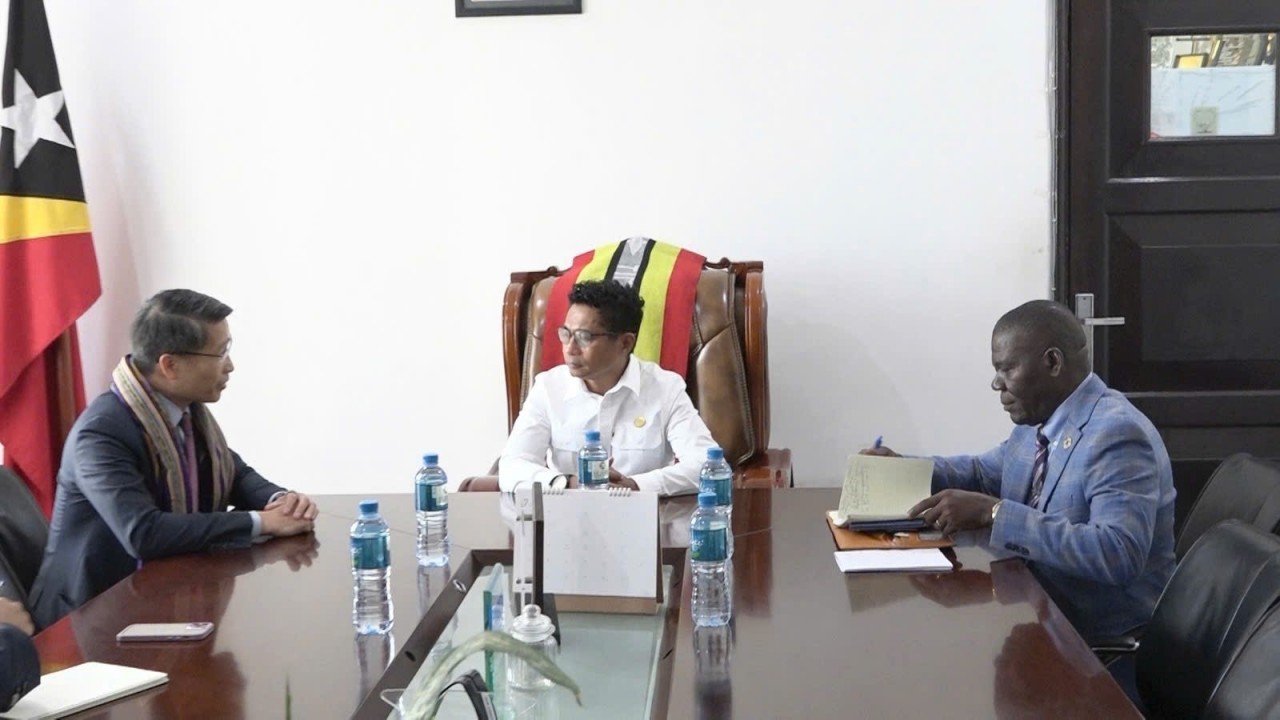 |
| A view of the working session. (Photo: VNA) |
On July 20, in Dili, Charge d'Affaires of Vietnam to Timor-Leste Pham Binh Dam held a working session with Deputy Prime Minister and Coordinating Minister for Social Affairs, concurrently Minister of Rural Development and Community Housing of Timor-Leste Mariano Assanami Sabino Lopes to discuss measures to promote cooperation in food security, rural development, the sustainable exploitation of marine resources, and human resource development.
According to the Vietnam News Agency (VNA) correspondent in Southeast Asia, Deputy Prime Minister Mariano Assanami Sabino Lopes said at the meeting that Timor-Leste's domestic production currently meets only about 40% of the country's food demand.
He noted that enhancing domestic production capacity is aimed not only at improving food self-sufficiency, but also at achieving broader social development goals, including improving nutrition, reducing poverty, creating jobs, and ensuring stable incomes for rural households.
Sharing Vietnam's development experience, Charge d'Affaires Pham Binh Dam stressed that food cooperation between the two countries could be developed on the basis of complementarity.
In the future, Vietnam will continue contributing to a stable supply of quality rice that meets the needs of the Timor-Leste market, thereby maintaining rice as an important commodity in bilateral trade.
In the longer term, cooperation should be expanded from trade to supporting local production capacity. Vietnam stands ready to share its experience in crop varieties, cultivation techniques, irrigation, mechanization, post-harvest preservation, and agricultural value chain development.
Regarding the fisheries sector, Deputy Prime Minister Mariano Assanami Sabino Lopes said Timor-Leste has a maritime area four times larger than its land territory and abundant fisheries resources. However, its capacity for fishing, preservation, and processing remains limited, and the fisheries sector has made only a modest contribution to the country's non-oil economy.
The Deputy Prime Minister expressed his hope that the two countries would strengthen exchanges of experience in fisheries exploitation, aquaculture, and seafood processing, initially to improve domestic food supplies, create more jobs and livelihoods for coastal communities, and subsequently move toward trade and exports.
Discussing future cooperation, Charge d'Affaires Pham Binh Dam said Vietnamese enterprises possess many strengths that match Timor-Leste's fisheries development needs, ranging from shipbuilding and the transfer of fishing and aquaculture technologies to investment in preservation facilities, cold storage, and processing.
On that basis, enterprises from both countries could explore suitable production cooperation models in Timor-Leste, linking investment with the recruitment and training of local workers while gradually transferring technical know-how to local communities.
On the same day, Charge d'Affaires Pham Binh Dam attended the launching ceremony of Timor-Leste's semi-industrial fishing vessels, organized by the country's Ministry of Agriculture, Livestock, Fisheries and Forestry.
Among the three vessels launched was one financed in part, constructed, and put into operation with the participation of a Vietnamese enterprise, demonstrating that Vietnamese businesses in Timor-Leste are gradually shifting from trade to production investment.
To ensure these projects operate effectively and can be expanded, both sides attached particular importance to human resources. Deputy Prime Minister Mariano Assanami Sabino Lopes said Timor-Leste has a large young workforce but still faces limitations in professional skills.
Charge d'Affaires Pham Binh Dam affirmed that Vietnam stands ready to cooperate with Timor-Leste in vocational training and capacity building for workers. This also represents a concrete step in implementing the education cooperation agreements signed during Prime Minister Kay Rala Xanana Gusmão's visit to Vietnam last June.
The two sides agreed to maintain exchanges and soon identify priority areas for implementation through concrete cooperation programs. Cooperation in food security should be carried out in tandem with rural development, livelihood expansion, job creation, and the improvement of human resources, thereby contributing to long-term stability and development in Timor-Leste.
 | National Steering Committee Strengthened for IUU Fight and Sustainable Fisheries Deputy Prime Minister Ho Quoc Dung has been appointed head of the National Steering Committee on combating illegal, unreported and unregulated (IUU) fishing, in a ... |
 | A Decade of Research Enhancing Food Safety: ILRI’s Contribution in Viet Nam The year 2025 marks the 75th anniversary of the Viet Nam Union of Friendship Organizations (VUFO). This is also an opportunity to look back and ... |
Most read


Related Stories
 National
Vietnam News Today (July 20): Diplomacy Opens New Pathways for Vietnam’s Development
 Economy
Vietnam, Mauritania Seek Stronger Cooperation in Agriculture, Telecommunications, and Mining
 Friendship
Can Tho Celebrates the 50th Anniversary of Vietnam - Philippines Ties
 National
Vietnam News Today (July 14): Vietnam, Indonesia Chart New Strategic Cooperation Agenda
Recommended
 Economy
Quang Ninh To Host 2027 APEC Finance Ministers' Meeting
Popular article
 Economy
Standard Chartered Raises Vietnam 2026 GDP Growth Forecast to 9,5%
 Economy
India launches its first hydrogen-powered train
 Economy